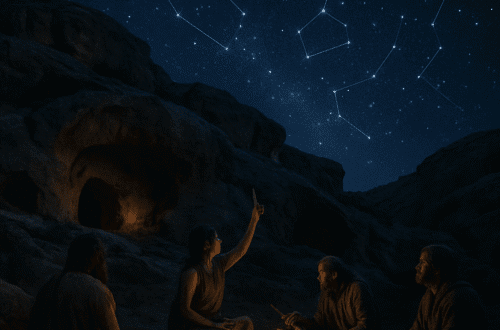
Astrology has always been more than fortune-telling in a newspaper column—it is one of the oldest and most enduring ways in which humanity has tried to make sense of the universe. Since the earliest civilizations, people have looked up at the stars and seen not just beauty, but guidance. The ever-shifting patterns of the night sky seemed to whisper secrets about time, destiny, and human life. From these early observations was born the history of astrology, a story as vast and fascinating as the cosmos itself.
In ancient Mesopotamia, priests carefully mapped the skies and linked celestial events with happenings on Earth. The Egyptians tied the rising of Sirius to the flooding of the Nile, proving that astrology was as much about survival as it was about belief. In India, astrology developed into Vedic astrology, also called Jyotish Shastra, a system rooted in the Vedas that connected planetary motions to karma and destiny. Meanwhile, across Asia, Chinese astrology evolved with its distinct zodiac animals and elements, anchoring an entire worldview that still influences festivals, marriages, and personal decisions today. And in Greece, thinkers like Ptolemy refined astrology into a structured system that Western astrology still follows, mapping out the familiar twelve zodiac signs.
What is striking is that despite being separated by oceans and culture, every society developed a system of astrology. Why? Because human beings have always needed more than food and shelter—we’ve needed meaning. The stars became a giant canvas where we painted our fears, questions, and hopes. To a farmer, astrology meant knowing when to plant crops. To a king, it meant deciding when to go to war. To everyday people, it meant comfort—that their destiny was not random, but tied to the greater rhythm of the cosmos.
Over time, astrology became part of culture, governance, and spirituality. Western astrology emphasized personality traits, relationships, and predictions of the future. Vedic astrology focused on life’s karmic lessons, dharma, and remedies to balance unhelpful cosmic influences. Chinese astrology gave a cyclical understanding of time, each year colored by the qualities of an animal sign. These weren’t just predictions—they were reflections of how humans saw themselves in relation to the universe.
Even today, in an era of science and technology, astrology hasn’t faded—it has adapted. Instead of clay tablets or handwritten charts, we now have zodiac apps and daily horoscopes on social media, but the essence remains the same. Millions of people still seek out birth charts, compatibility readings, or planetary transits, not necessarily because they believe every word, but because astrology speaks to something eternal: the desire to understand ourselves and our place in the cosmos.
Perhaps that is the real importance of astrology. It may not always provide measurable proofs like science, but it provides language for meaning, for connection, for hope. It bridges the gap between human life and the universe above, reminding us that while the stars may be light-years away, their stories are woven into our own. And as long as the night sky continues to shimmer, mankind will keep looking up, searching for answers among the stars.